
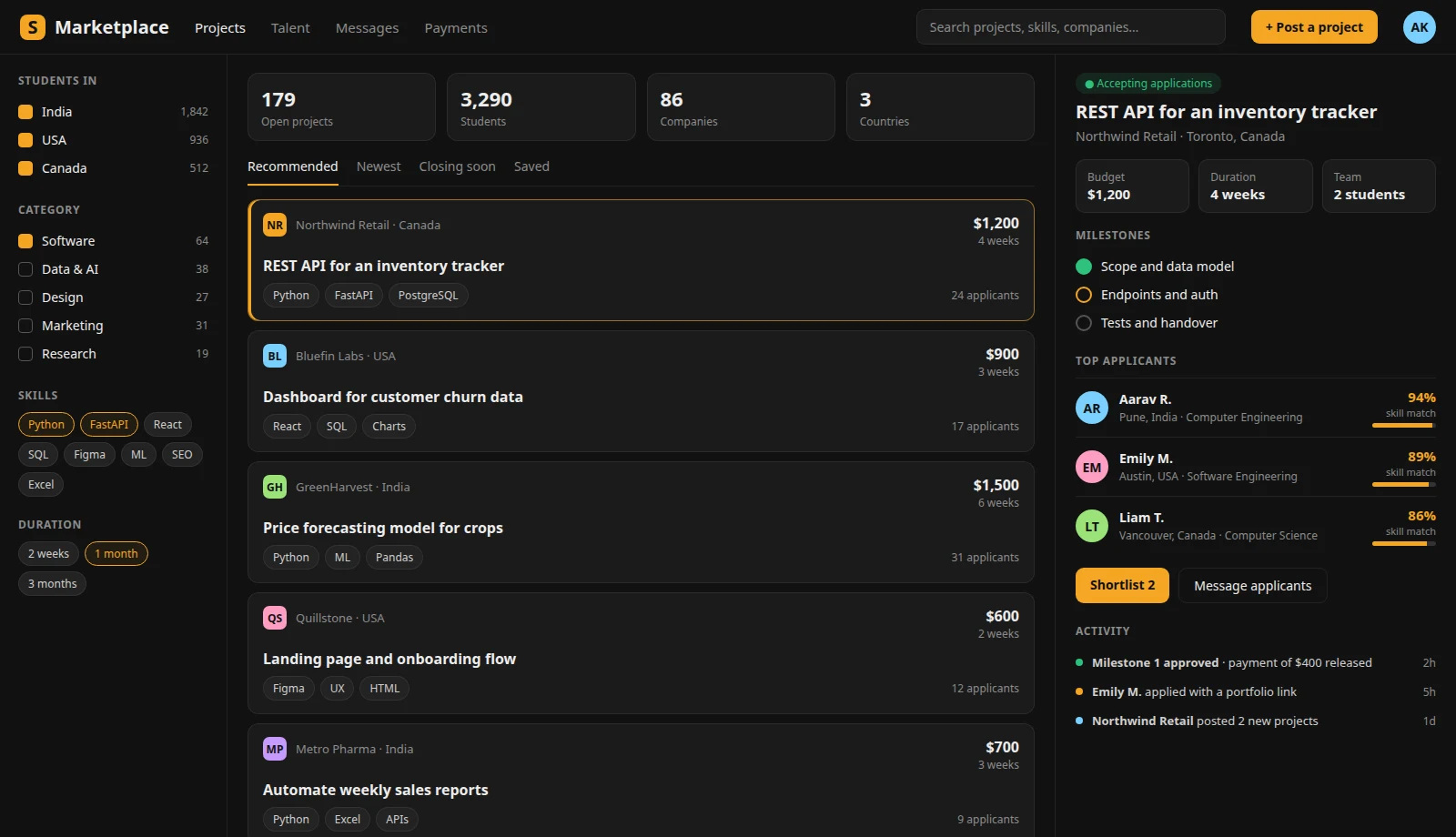
Most students meet the industry for the first time after they graduate. The platform started from a simple idea: what if they met it while still in college, by doing real work for real companies, the way freelancers do on Fiverr or Upwork?
I worked on the backend that powered it, in Python with FastAPI.
The idea
Learning the industry by working in it
A degree teaches the theory. What it rarely teaches is how work actually happens in a company: real requirements, real deadlines, real feedback from someone who needs the result. The marketplace brought that into college life. Companies posted projects, and students in India, the USA and Canada could pick them up and deliver them, building experience and a track record before their first job.
- PostA company puts up a real piece of work it needs done.
- Pick upStudents find projects that match what they want to learn.
- DeliverThe student does the work, and the company gets a real result.
- GrowThe student leaves with industry experience before graduating.
My part
The backend
My work was on the backend: the APIs the platform ran on, built in Python with FastAPI. A marketplace lives or dies by its backend. Every listing, every student, every application and every hand off between a company and a student passes through it.
FastAPI suits that kind of product well. It’s fast and asynchronous, so it handles many requests at once, and it checks every request against typed models before any code runs, which keeps bad data out. It also generates live API documentation automatically, which makes it easier for the frontend and backend to stay in step.
Today
Where the idea went
The platform has grown since. Today it describes itself as an experiential learning platform: people build skills through projects that mirror real work, with AI guidance and feedback from experts along the way. It partners with universities including IIT Kharagpur, IIT Bhubaneswar and Manipal University, and is based in San Jose, California.
The core idea never changed: you learn the industry best by working in it.